Artificial Intelligence is evolving faster than ever, and 2026 is proving to be a turning point in the way businesses use AI-powered applications. For years, traditional chatbots were considered one of the biggest innovations in customer support and automation. However, a new generation of technology known as AI Agents is now changing the landscape completely.
From handling complex business operations to making independent decisions, AI agents are quickly replacing traditional chatbots across industries including healthcare, finance, education, eCommerce, logistics, and mobile applications.
What Are Traditional Chatbots?
Traditional chatbots are rule-based or partially AI-powered systems designed to respond to predefined questions and commands. These bots are commonly used for:
- Customer support
- FAQ handling
- Appointment booking
- Order tracking
- Basic automation
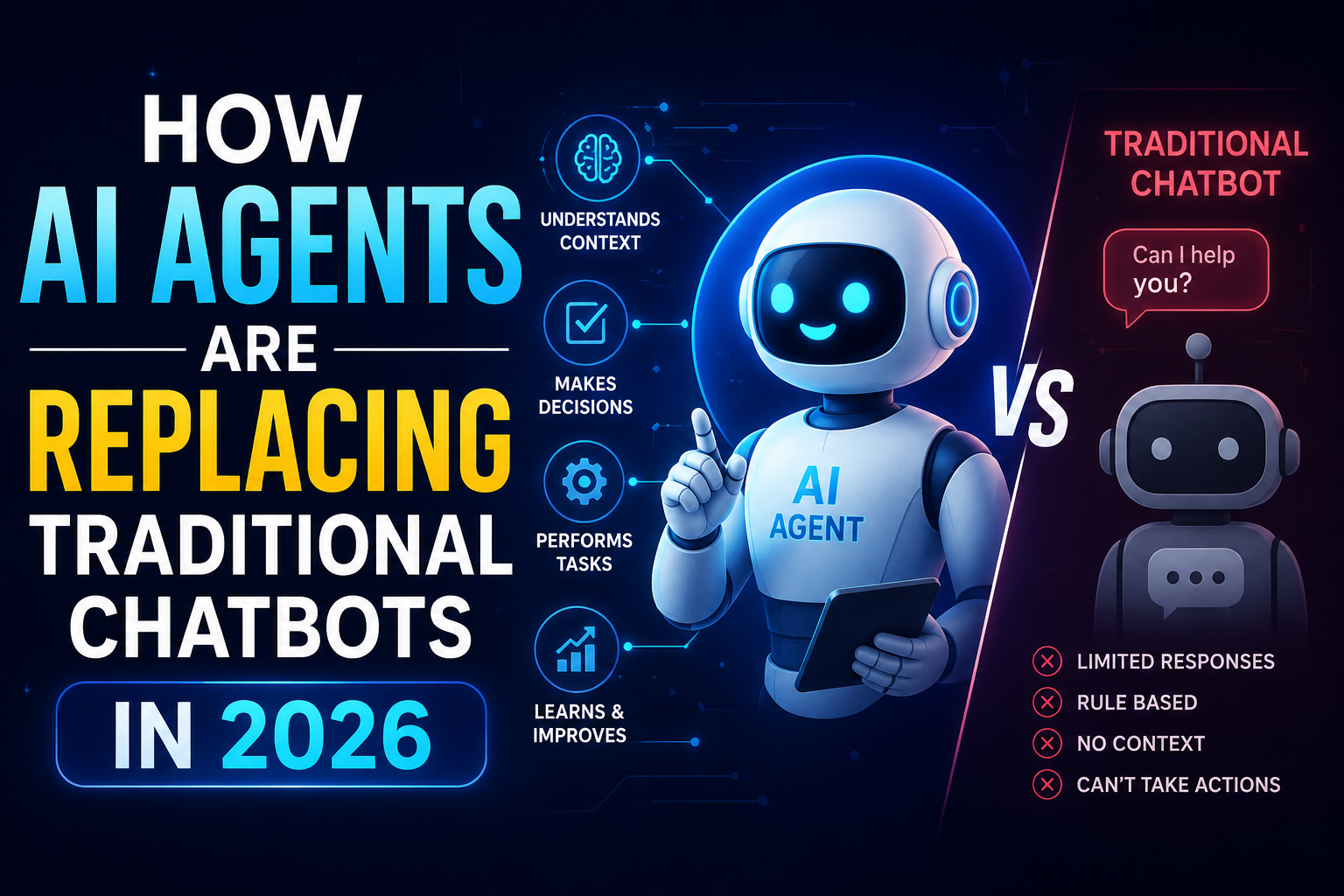
While chatbots improved customer engagement, they often struggled with:
- Understanding context
- Multi-step tasks
- Human-like conversations
- Personalized decision-making
- Complex workflows
This limitation created the need for more intelligent systems.
Enter AI Agents
AI agents are advanced AI systems capable of performing tasks autonomously with minimal human intervention. Unlike traditional chatbots that simply respond to questions, AI agents can:
- Analyze data in real time
- Learn from interactions
- Make decisions
- Perform multi-step actions
- Interact with external tools and software
- Adapt to user behavior
In simple terms, AI agents do not just “talk” — they “act.”
Why AI Agents Are Growing Rapidly in 2026
Major tech companies including Google, Microsoft, Meta, and OpenAI are heavily investing in agentic AI systems. Businesses are also rapidly adopting AI agents because they improve efficiency and reduce operational costs.
Some major reasons behind this shift include:
1. Better Context Understanding
AI agents can remember previous conversations, user preferences, and ongoing tasks, creating a more natural experience.
2. Task Automation
Instead of simply answering questions, AI agents can complete actions such as:
- Booking meetings
- Managing workflows
- Sending reports
- Processing orders
- Updating CRM systems
3. Personalized Experiences
AI agents analyze user behavior and provide smarter recommendations and solutions tailored to individual users.
4. 24/7 Intelligent Assistance
Unlike traditional support systems, AI agents continuously learn and improve over time, making them more efficient with every interaction.
Industries Being Transformed by AI Agents
Healthcare
AI agents are helping patients schedule appointments, monitor health data, and provide preliminary medical guidance.
Finance
Banks and fintech companies are using AI agents for fraud detection, customer assistance, and automated financial planning.
eCommerce
Online stores are implementing AI shopping assistants that can recommend products, track deliveries, and manage returns automatically.
Education
AI-powered learning assistants are providing personalized study plans and real-time tutoring experiences.
Mobile Applications
AI agents are becoming a key feature in modern mobile applications by improving user interaction, automation, and engagement.
Traditional Chatbots vs AI Agents
| Feature | Traditional Chatbots | AI Agents |
|---|---|---|
| Rule-Based Responses | Yes | No |
| Context Awareness | Limited | Advanced |
| Decision Making | Minimal | Intelligent |
| Task Execution | Basic | Multi-Step |
| Learning Ability | Limited | Continuous |
| Personalization | Basic | Highly Advanced |
The Future of AI-Powered Applications
The rise of AI agents signals a major transformation in software and application development. Businesses are no longer looking for systems that simply answer questions — they want intelligent applications capable of handling operations, improving customer experiences, and increasing productivity.
As AI technology continues to evolve, AI agents are expected to become a standard feature in:
- Mobile applications
- Business automation platforms
- Customer service systems
- Enterprise software
- Smart devices
Final Thoughts
The shift from traditional chatbots to AI agents is one of the biggest technology trends of 2026. Companies adopting AI-driven applications early are likely to gain a strong competitive advantage in the coming years.
Businesses exploring modern AI solutions are now focusing on smarter, more adaptive applications that go beyond basic automation. Companies such as Mobile Applications Online are also observing this transition closely while working on modern application development solutions aligned with evolving AI trends.